

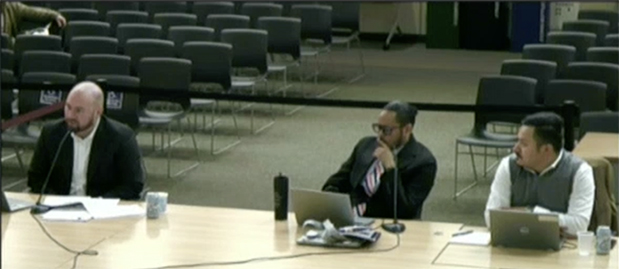
PAB Chair Joshua Cayetano, ODPA Director Hansel Aguilar, ODPA Policy Analyst José Murillo
The Berkeley City Council held a special meeting on November 18th, 2025, with the agenda containing a single item: the annual Police Accountability Board (PAB) report. This report was comprehensive, being presented by both the Office of the Director of Police Accountability (ODPA) and the PAB, including Hansel Aguilar, Director of the ODPA, Joshua Cayetano, Chair of the PAB, and José Murillo, Policy Analyst for the ODPA. All council members were in attendance for this meeting, with the PAB clarifying that this report was the 2024 annual report.
The presentation began with Aguilar drawing a clear distinction between the PAB and the ODPA, highlighting that they are two separate entities working in unison to provide oversight for the Berkeley Police Department (BPD). He further stated that while the PAB has broad policy practice, the ODPA is the investigative and administrative arm for the oversight system, providing “day-to-day work that supports the PAB.” After Aguilar stated that the main purpose of the board is to provide timely, effective, and fair investigations into complaints, Murillo then explained that the PAB and ODPA operate on a complaint-driven system without the authority to self-initiate complaints.
The first major topic of discussion for the report was the 2024 complaint data. In total, the board received 53 complaints, after which 459 allegations were investigated, resulting in 51 of the complaints being closed. After board consideration, 97 of the allegations were reviewed by the chief of the BPD. Of these allegations, however, only six were sustained by the PAB and only one was sustained by the chief, creating a 16.67% agreement rate between the two. Murillo also noted that, in 2024, seven allegations were elevated to the city manager’s level. Of these seven, the city manager sustained only three of them, resulting in a 42.86% agreement rate between the city manager and the PAB—which Cayetanno emphasized was marginally higher than the previous year’s 0%.
After this, Cayetanno transitioned to discussing the policy and procedure work done by the board in 2024. He highlighted that the PAB’s bandwidth in terms of policy work is constrained by its size, consisting of only 6 volunteers. However, he said that 2024 was a big year for the board’s policy work. Cayetanno first mentioned a resolution issued on April 15, 2025, “condemning any and all racism and misconduct, affirming the City Council’s opposition to arrest quotas, asking the California legislature to extend the prohibition on arrest quotas which are currently limited to the California Vehicle Code.” He then stated that, “at [the PAB’s] last meeting, Deputy Chief Tate, actually proposed language to us that I personally support…and I would expect that would be coming before this council at a future meeting.” Cayetanno then moved on to discussing the Fair and Impartial Policing Report, a product of a task force initiated
in 2021 and an identification that Berkeley had huge racial disparities which needed to be addressed. The presentation stated that, “Black Berkeley residents were 6.55 times as likely to be stopped as White Berkeley residents,” and that “Black individuals were 10.5 times as likely to be searched as White individuals.” In order to combat this, the PAB has a pending action recommending that the council measures the effectiveness of the BPD’s three-pronged approach to narrowing the racial disparity gap. The final major policy achievement was the Vehicle Pursuits Policy, which Cayetanno highlighted as an example of the PAB and BPD working together. He stated that it was a productive discussion surrounding best practices, in which the PAB had one recommendation around the use of forcible pursuit intervention techniques. The PAB submitted that recommendation this year to the city manager’s office, resulting from negotiations that were set to heighten the standard. Berkeley officers could initiate a forcible pursuit intervention technique on the streets of Berkeley, which right now, according to Cayetanno, “is subject to a reasonability balancing test, which is very difficult to apply in the heat of the moment.” The PAB recommended that BPD adopt the use of deadly force standard, which many other jurisdictions have adopted, including San Francisco.
The next part of the report covered BPD trends and patterns in vehicle and pedestrian stops, as well as other enforcement activities. Murillo stated that the data was gathered using a population-based method, and in 2024, the BPD conducted a total of 4773 stops, of which racial disparities persisted throughout. According to the data, citations, arrests, and psychiatrics hold consistent with prior years, with stops being concentrated around Districts 1, 2, 3, and 4. Murillo also covered use of force trends, emphasizing that out of 294 total incidents, 742 officers, and 322 subjects, Black individuals were involved 154 (47.83%), White individuals were involved in 96 (29.81%), Hispanic individuals were involved in 45 (13.98%), and Asian, Bi-Racial, Native
American, Indian, or Unknown were involved in 16 (5.44%). Cayetanno closed this part of the presentation off by stating that the requirement of presenting on use of force trends had been cut “without input from this council or the PAB.”
The final section of the report covered 2024’s challenges for the board, and the recommendations it has for moving forward. Aguilar stated that there were three clear issues that the board faced: incomplete implementation of charter initiatives, disputes regarding scope of authority, and operational constraints (staffing and classification challenges, infrastructure and IT delays). It was also noted that the board wants identified separation within charter language, because in practice, there hasn’t been a recognized separation of PAB board staff and ODPA board staff, instead referencing them as a singular entity. The PAB presented several recommendations for the council, including finalizing and adopting permanent oversight regulations, addressing racial disparities in police stops and use of force, enhancing public engagement, strengthening oversight of surveillance and specialized units (mostly relating to the Downtown Task Force report), and supporting subcommittee engagement with policy reform capacity. In addition to these recommendations, the ODPA also presented several recommendations of their own, including the establishment of oversight-specific civil service classifications, enhancement of infrastructure and IT coordination for charter compliance, the adoption of standardized complaint subcategorization and improvement of trend analysis, the ensuring of adequate resources for civilian oversight operations, and the investment in youth engagement and inclusive outreach; however, he noted that the PAB was working to expand engagement.
Following the end of the presentation, the council moved into Q&A, where the board answered a variety of clarifying questions—the most important of which surrounded the data presented. Councilmember Brent Blackaby presented the question of whether or not the BPD traffic stop data showed any bias, as the graph did not enumerate any such racial disparities. Aguilar answered the question by stating that we need to look at the criminal justice spectrum that isn’t represented by data. He highlighted the need for qualitative data from bodyworn cameras, and posed the question: “What happens when people go to courts, are the cases yielding convictions? Because of limitations with data we need to look at the phenomenon in its entirety.” Aguilar claimed that even if the numbers suggest no bias, the real-world interactions (including demeanor shifting when people subjected to BPD stops vary from one racial background to another) show nuance. The meeting came roughly to a close after Councilmember Cecilia Lunaparra, relating to previous questioning of traffic stop data and whether it consists of residents of Berkeley, stated, “I wanted to briefly push back on the notion or insinuation that the reason for these racial disparities is because of people of color coming into Berkeley from other cities… I find the insinuation to be dangerous and dismissive of the very real experiences of many of our residents of color here in Berkeley, and does not do anything to build trust between our government and communities of color, especially our Black and Brown residents.”
–Brayden Livingston and Lucy Still
All League News